A homeschool conference session on technology, AI, and the future of work left me with questions I do not want to evade.
The speaker’s warnings were strong. He connected AI to economic disruption, spiritual compromise, and even the possibility of antichrist-like systems. He reached for the biblical world of meat offered to idols and for the pressure of participating in commerce on terms set by a pagan culture. The warning was clear: Christians should not drift into using powerful systems without asking what kind of allegiance they demand.
I do not agree with every conclusion or every analogy. I am not ready to call AI the Antichrist, and I do not think the mere act of using an LLM is the same as offering worship to an idol.
But I do not want to wave the concern away either.
Part of why I cannot is the language surrounding AI itself. Some of it is plainly Silicon Valley hyperbole: Elon Musk’s line about “summoning the demon” was an alarm about human overconfidence in controlling a powerful system, and Stephen Hawking was making a speculative risk forecast about what a self-improving intelligence might do. But some of the god-language is not merely metaphor. In a striking fringe example, Anthony Levandowski’s Way of the Future was organized around the stated worship of an AI “Godhead.” I should not turn one project into a conspiracy theory about every model, engineer, or user. But neither should I sweep it under the rug just because I find these tools useful.
If people are actually trying to create a god, hand ultimate authority to an artifact of human hands, or use technological power as a substitute for creaturely dependence on God, Christians should recognize the old temptation to exchange the Creator for a creature. The fact that an LLM can be useful does not settle that concern. It means we have to ask better questions: what am I actually participating in, what is this tool asking of me, what is it training me to love and trust, and where must I draw a line?
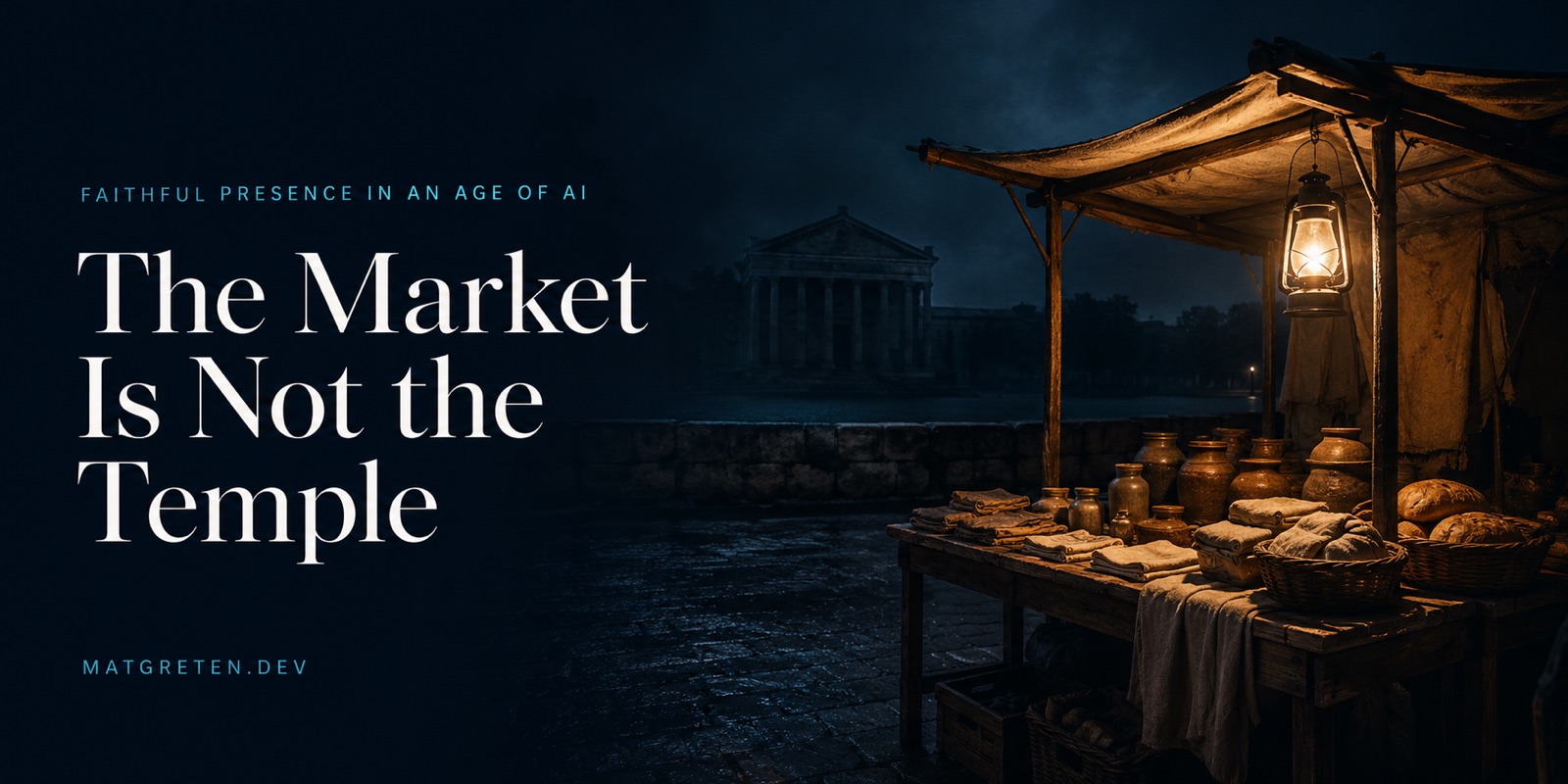
The market is not the temple
Paul’s teaching about food offered to idols gives me a better category than either casual permission or total withdrawal. In 1 Corinthians 8 and 10, he is uncompromising about actual idol worship: Christians cannot join in a sacrificial meal as fellowship with idols. But he also tells believers to eat what is sold in the marketplace without turning every purchase into an investigation of its spiritual provenance, because “the earth is the Lord’s.”
That is not a loophole for carelessness. Paul insists that love, conscience, and the good of one’s neighbor still govern Christian freedom. But it does distinguish buying meat in a compromised economy from entering the temple and sharing in its worship. The market is not the temple.
That distinction matters here. The fact that an AI tool was made by people with mixed motives, ideological commitments, or even idolatrous ambitions does not by itself mean that every use is participation in their worship. It means I have to examine the actual use: whether it asks me to sin, whether it requires false allegiance, whether it harms my neighbor, whether it entangles me in a practice I cannot faithfully support, and what it forms in me.
Revelation does warn of a world in which buying and selling are bound up with the beast. But in Revelation 13 and 14, the decisive issue is worshipful allegiance—not ordinary commerce itself. That warning should make Christians alert to any system that demands false worship or disobedience to Christ. It should not make us call every powerful or morally compromised technology the beast.
Not neutral, not sovereign
Albert Mohler has helped me put words around part of this tension. AI use is not automatically sinful. Christians have always used tools. We use trucks, planes, computers, buildings, machinery, medicine, and ordinary human ingenuity. We do not worship machinery, but neither do we assume that reducing needless labor is a betrayal of human dignity. There is a real dominion mandate in cultivating the world, making things, and using creation responsibly.
But Mohler also says there is no such thing as a morally neutral technology. That does not mean every technology is inherently evil. It means every technology comes with consequences and trade-offs: moral, economic, political, cultural, and personal. A tool can extend human ability while also rewarding certain habits. It can solve one problem while creating another. It can offer convenience while quietly teaching us to avoid responsibility.
LLMs are trained on other people’s words, assumptions, morality, interests, and worldviews. They come out of companies with incentives. They can reproduce bias, error, manipulation, pornography, deception, and a thousand old sins in new forms. But neither are they sovereign powers that remove our responsibility.
A master craftsman can use a tool manufactured by a greedy or wicked company without becoming the company. The tool may carry risks, limitations, and baggage. The craftsman still has to know his work. He still has to judge the result. He is still accountable for what he makes and what he does with it.
Joshua Sheats makes an important adjacent point in his episode on the ethics of AI. Once a capability exists, Christians cannot settle the question by wishing it had never been developed. The question becomes how it will be used: whether we will seek the good, restrain the bad, and help guide the systems that are already shaping the world around us.
That does not make adoption a moral duty for every person, and it does not make every use permissible. But complete withdrawal is not the same as faithfulness. If Christians refuse to learn enough to judge these tools or to participate in the decisions around them, others will still build, deploy, and govern them. Discernment has to become more than critique. It should form people who can protect their neighbors, serve their communities, and exercise real responsibility where they have influence.